
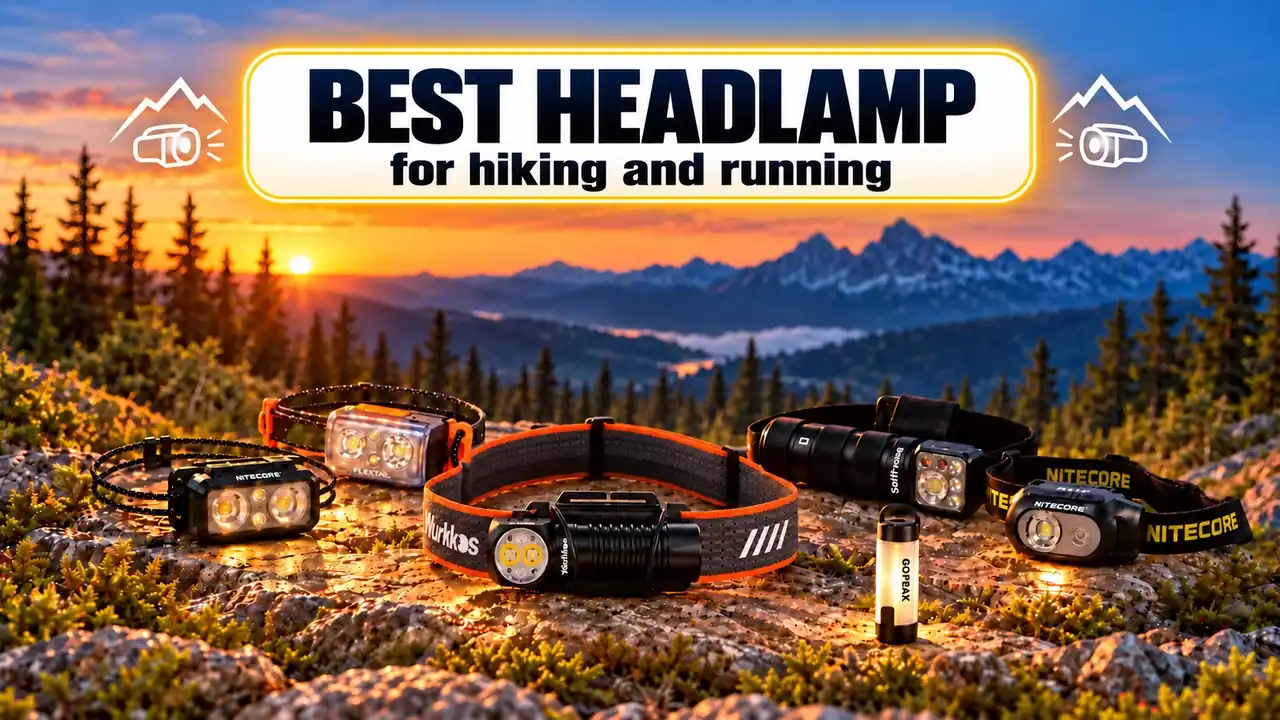
Best Headlamp for Hiking & Running: Lightweight Budget Picks
The best headlamp for hiking isn’t the one that blinds everyone at the trailhead. It’s the one that lasts your whole run or hike – or that unplanned evening dash to the nearest hut before a storm – weighs almost nothing in your pack and charges wherever you happen to be.
In this guide I compare lightweight headlamps and small flashlights for hiking, running and the outdoors that also work at home or in an emergency – from a $3 pocket light to a powerful bike headlamp. They’re grouped by weight, the table lets you sort them by price, brightness and features, and for each one I say who it’s for and who should skip it. You’ll find the best running headlamp, the best budget headlamp and the best headlamp with red light for the tent.
I own and use the Sofirn HS42, Fenix HM51R and Gopeak Mini, and I weighed those plus the Sofirn HS10 myself. For the rest I rely on manufacturer specs and independent reviews, which I always link.
🔦 Quick picks: the best headlamp for each use
- Best headlamp overall and best value: Wurkkos HD12
850 lumens, red light, IP68 and USB‑C charging – and when the battery dies, it runs on a regular AA. All for around $31. See the deal →
- Best running headlamp: Nitecore NU25 MCT UL
Just 47 g (1.7 oz) including the headband, 400 lumens and red light. See the deal →
- Best rechargeable headlamps: Wurkkos HD12 and Flextail Tiny Helio 600Z
The HD12 charges via USB‑C and takes a AA in a pinch. The Tiny Helio is lighter (62 g / 2.2 oz) and has a swappable RCR123A battery, including a cold-weather version. Wurkkos HD12 → · Flextail Tiny Helio 600Z →
- Best for home and emergencies: Wurkkos HD12 and Nitecore HA11
Both run on a standard AA you already have in a drawer and can buy at any gas station. The HD12 also recharges itself; the HA11 is lighter and cheaper. Wurkkos HD12 → · Nitecore HA11 →
- Brightest headlamp: Sofirn HS42
The most light in this guide (~1,460 lumens measured), an 18650 battery and red light for the price of a budget headlamp. See the deal →
- Best pocket and emergency light: Gopeak Mini
18.7 g (0.66 oz), magnet and clip – you’ll carry it everywhere. See the deal →
📊 Headlamp comparison and map: pick what matters to you
Choose what you want to see to the north and what to the east. The map shows where each headlamp lands, and the table below sorts itself from best to worst. Hover over a headlamp to see its specs, click to jump to its review.
Hover over or tap a headlamp on the map.
| Model | Price | Weight with battery | Max. output | Power | Features |
|---|---|---|---|---|---|
| Sofirn HS42 | from $35 | 161 g / 5.7 oz ⚖️ | ~1,460 lm ² | 18650, USB‑C | 5/7 · USB‑C, swappable battery, red light, magnet/clip, lockout |
| Sofirn SP40 | from $23 | 141 g / 5.0 oz | 1,200 lm | 18650 / 18350, USB‑C | 5/7 · USB‑C, swappable battery, IP66+, magnet/clip, lockout |
| Sofirn HS10 | from $25 | 75 g / 2.6 oz ⚖️ | 1,100 lm | 16340, USB‑C | 5/7 · USB‑C, swappable battery, IP66+, magnet/clip, lockout |
| Wurkkos HD12 | from $31 | 106 g / 3.7 oz | 850 lm | 14500 / AA, USB‑C | 6/7 · USB‑C, swappable battery, disposable backup, red light, IP66+, magnet/clip |
| Flextail Tiny Helio 600Z | from $42 | 62 g / 2.2 oz | 600 lm | RCR123A, USB‑C | 3/7 · USB‑C, swappable battery, IP66+ |
| Lumintop Black Cat | from $21 | 22 g / 0.8 oz | 400 lm (30 s) | built-in, USB‑C | 2/7 · USB‑C, magnet/clip |
| Nitecore NU25 MCT UL | from $31 | 47 g / 1.7 oz | 400 lm | built-in, USB‑C | 4/7 · USB‑C, red light, IP66+, lockout |
| Nitecore HA11 | from $23 | 62 g / 2.2 oz | 240 lm | AA / 14500 | 6/7 · swappable battery, disposable backup, red light, IP66+, magnet/clip, lockout |
| Gopeak Mini | from $3 | 18.7 g / 0.66 oz ⚖️ | – | built-in, USB‑C | 2/7 · USB‑C, magnet/clip |
| Alonefire X29 | from $10 | 37.4 g / 1.3 oz ¹ | – | CR123A / 16340 | 3/7 · swappable battery, disposable backup, magnet/clip |
| Alonefire X81 | from $11 | ~34 g / 1.2 oz ³ | – | 10440, USB | 3/7 · USB‑C, swappable battery, magnet/clip |
Map colors: gray = ultralight under 50 g (1.8 oz), green = all-round 51–140 g (1.8–4.9 oz), red = high-output over 140 g (4.9 oz). Features = how many of 7 practical features a model has: built-in USB‑C charging, swappable battery, disposable battery as a backup, red light, IP66 or better, magnet or clip, lockout. ⚖️ weighed by me · ¹ measured in an independent video review · ² independent measurement (manufacturer claims 2,100 lm) · ³ 24 g body per seller + 10440 cell approx. 10 g · – not stated by manufacturer/seller. Lumens are maximum short-term output, not sustained output. Prices are approximate.
🧭 Types of lights: headlamp, small flashlight or modular?
There are 3 basic types of lights that work well for hiking, running and the outdoors.
🏃 Headlamp: hands-free
- The light stays on a headband, so your hands are free.
- It shines where you look.
- The most practical choice for running, hiking, biking and cooking in the dark.
🔦 Small handheld flashlight: always at hand
- Smaller and lighter than a headlamp, but you mostly hold it in your hand.
- You can wear it with a clip on a cap brim, a magnet or an extra headband – though it’s usually less comfortable than a headlamp.
- Ideal as a backup and emergency light you always carry.
⚙️ Modular light: on your head or in your hand
- The light pops out of its holder and works as a handheld flashlight or clips onto a pack strap.
- In this guide, that applies to the Wurkkos HD12 and Fenix HM53R (magnetic tail cap), the Nitecore HA11 (clips onto a cap brim or pack) and the Sofirn HS42 (magnetic tail cap, comes out of the headband holder).
⚖️ Our weight classes
I group the models by the weight of the ready-to-use setup: headlamps with battery and headband, flashlights with battery and clip. These limits are our own editorial choice, not an industry standard.
- 🪶 Ultralight under 50 g (1.8 oz) – the lightest headlamps and pocket lights. For running, camping, reading in the tent or as a backup in your pocket. Runtime and output are lower, but you’ll barely notice you’re carrying them.
- 🥾 All-round 51–140 g (1.8–4.9 oz) – a balance of runtime, output and comfort. Night hikes, backpacking, running and other sports, plus a reliable emergency light.
- ⛰️ High-output over 140 g (4.9 oz) – over 1,000 lumens and a big battery. Biking, ski touring, mountains and off-trail navigation. Too heavy for running.
📋 What makes the ideal lightweight headlamp
These are my universal criteria for choosing a headlamp. Depending on whether you want it mainly for running, hiking, biking or your emergency kit, prioritize the features that matter most to you.
| 🪶 Weight | The lightest complete setup – the headlamp with battery and headband, not just the body out of the box. The difference is often tens of grams. |
|---|---|
| ⏱️ Runtime | The longest runtime in the mode I actually use. “Up to 100 hours” applies to the dimmest setting, and maximum output only lasts a short while. |
| 🔋 Charging and battery | USB‑C charging and ideally a swappable battery. The best headlamps take both a rechargeable cell and a regular disposable battery you can buy anywhere. |
| 🔴 Light modes | A headlamp with red light for the tent and map reading, a very low moonlight mode around 1 lumen and a sensible range of other modes. |
| 💡 Output and beam distance | Reasonable sustained output and a strong short burst for distance. |
| 🌧️ Durability | At least IPX4 for rain, ideally IP67–IP68 for snow and water. A lockout to prevent it turning on in your pack. |
| 🧲 Modularity | Clip, magnet, removable from the headband. |
| 💲 Price | I look for the best value for money. I only pay extra for a brand when I get something more for it. |
No headlamp ticks every box. For each model, I explain what it does well and what trade-off it comes with.
🔋 Headlamp batteries and charging: what works in practice
🔌 Rechargeable headlamp or swappable battery?
A rechargeable headlamp with a built-in battery is the lightest and most convenient option – all you need is a power bank and a USB‑C cable. But if it dies in the middle of the night, you have nothing to swap in. The most versatile setup is USB‑C charging plus a swappable battery: you can charge the headlamp anywhere and still carry a spare cell, ideally even a regular disposable battery.
- Built-in battery + USB‑C – lightest and most convenient, charges from a power bank. But when it’s empty, there’s no backup. Ideal for running and day hikes.
- Swappable Li-ion cell – carry a charged spare, and the headlamp can deliver higher output. You do need quality cells. For backpacking, biking and winter.
- Rechargeable batteries with their own USB‑C port – AA/AAA as well as 16340, 14500 or 18650 cells that charge with a cable right in the battery, no charger needed. A good combination of a swappable battery and easy charging.
- Regular AA/AAA batteries – available anywhere in the world. But alkalines fade at higher output and fail in the cold. For travel and emergency kits.
❄️ Charging on the trail, in winter and on a plane
- USB‑C built into the headlamp saves you a charger – the power bank you carry for your phone is enough.
- Cold reduces the capacity of Li-ion and NiMH. Keep the headlamp or a spare cell in a pocket close to your body. Disposable lithium AA/AAA handle cold far better than alkalines.
- Flying: spare Li-ion cells belong in your carry-on, protected against short circuits. Check the rules with your airline.
- Storage: put disposable lithium batteries in your emergency kit – they last for years. Top up a Li-ion cell in a stored light now and then.
📏 Battery formats at a glance
| Format | Rechargeable | Disposable | Size | Weight (approx.) |
|---|---|---|---|---|
| AAA | Li-ion 10440 3.7 V, 300–350 mAh · NiMH 1.2 V, 800–1,000 mAh | alkaline, lithium (1.5 V), 1,000–1,200 mAh | 10.5 × 44.5 mm | 8–12 g |
| AA | Li-ion 14500 3.7 V, 700–1,000 mAh · NiMH 1.2 V, 1,900–2,500 mAh | alkaline, lithium (1.5 V), 2,000–3,000 mAh | 14.5 × 50.5 mm | 15–30 g |
| CR123A | Li-ion 16340 / RCR123A 3.7 V, 550–1,150 mAh | lithium CR123A (3 V), 1,300–1,600 mAh | 17 × 34.5 mm | 15–17 g |
| 18650 | Li-ion 3.7 V, 2,500–3,500 mAh | – | 18 × 65 mm | 45–50 g |
| 21700 | Li-ion 3.7 V, 4,000–5,000 mAh | – | 21 × 70 mm | 65–70 g |
How to read the labels: the number is the size – the first two digits are the diameter in mm, the next two the length. So a 14500 is 14 × 50 mm, like a AA. ⚠️ Same size doesn’t mean same voltage: Li-ion 10440 and 14500 cells are 3.7 V, while regular AAA and AA are 1.2–1.5 V. Never use them in a light that doesn’t explicitly support them – the Nitecore HA11, for example, does allow 14500. Never recharge disposable batteries.
🔋 Compare capacity in Wh, not just mAh. Energy = mAh × voltage. A Li-ion 14500 with 800 mAh (3.7 V) holds about 3 Wh, a NiMH AA with 2,000 mAh (1.2 V) about 2.4 Wh. Alkalines also only deliver their capacity at low draw – at high headlamp output, you get much less of it.
✅ Recommendations by priority
- Lowest possible weight: built-in battery (Nitecore NU25 MCT UL, Gopeak Mini).
- Batteries you can buy anywhere: a single AA, ideally with 14500 support (Nitecore HA11).
- Rechargeable headlamp with an emergency backup: Li-ion 14500 + regular AA (Wurkkos HD12), or 18350/16340 + CR123A (Fenix HM53R).
- Output and long runtime: 18650 with USB‑C (Sofirn HS42).
🪶 Ultralight headlamps and flashlights under 50 g (1.8 oz): for running, camping and your pocket
The lightest lights in this guide. The best running headlamp, plus pocket flashlights you can carry all the time – at most you’ll clip them to a cap brim.
Nitecore NU25 MCT UL

🏃 Best running headlamp and the lightest headlamp in this guide
Nitecore NU25 MCT UL is the lightest full-featured headlamp in this guide. 47 g (1.7 oz) including the holder and shock-cord headband, 400 lumens, a 132 m beam and a built-in 700 mAh battery with USB‑C charging.
🎯 Best for: Running, fast hikes and thru-hikes where every gram counts. It’s the best running headlamp in this guide.
- 🪶 Lowest weight among the headlamps – 47 g with headband.
- 🔴 Red light with two levels.
- 🌈 Three color temperatures – warm, neutral and cool.
- 🔒 Lockout against accidental activation and a battery indicator.
- 💧 IP66 rated.
- Built-in battery – you’ll need a power bank on longer trips.
- The maximum 45 h runtime only applies to the lowest mode.
🚫 Skip it if: You want a strong long-range beam for biking or off-trail terrain – the Sofirn HS42 is better for that.
🔄 Cheaper alternative: The older Nitecore NU20 Classic is 9 g lighter (38 g / 1.3 oz), but the manufacturer doesn’t list a red light and the battery is smaller (500 mAh).
📋 Specs:
- Power: built-in 700 mAh Li-ion, USB‑C
- Output: 400 lm, max runtime 45 h
- Durability: IP66, 1 m drop resistant
Gopeak Mini

🔦 Best pocket and emergency light (EDC)
Gopeak Mini is the lightest light in the whole guide and the only pocket light here that I use myself. It weighs 18.7 g (0.66 oz), so in your pocket, on your keys or on a pack strap, you’ll hardly know it’s there.
🎯 Best for: A permanent backup light for your pocket, keys or first-aid kit. For a short dog walk or finding things in the tent, it’s enough as your main light too.
- 🪶 Lightest light in this guide – 18.7 g.
- 🔌 USB‑C charging.
- 🧲 Magnetic tail and removable clip – according to buyers, it fits a cap brim too.
- 🏮 White and warm side light works as a small lantern.
- The seller doesn’t list lumens or runtimes.
- No red light.
- Built-in battery can’t be swapped on the trail.
- Charging needs a longer-than-usual USB‑C plug – a suitable cable is included.
🚫 Skip it if: You need light for night running or a whole night on the trail. Go for a headlamp like the Nitecore NU25 MCT UL.
🔄 Cheaper unbranded version: The cheapest option is an unbranded version – on AliExpress it’s sold as Outdoor Strong Light LED Flashlight mini Portable Keychain Light or Mini 5050 Rechargeable LED Pocket Flashlight. It looks the same, but I haven’t verified its quality or specs.
📋 Specs:
- Power: built-in battery, USB‑C charging
- Mounting: magnet, removable clip, key ring
- Light: main LED + white and warm side light
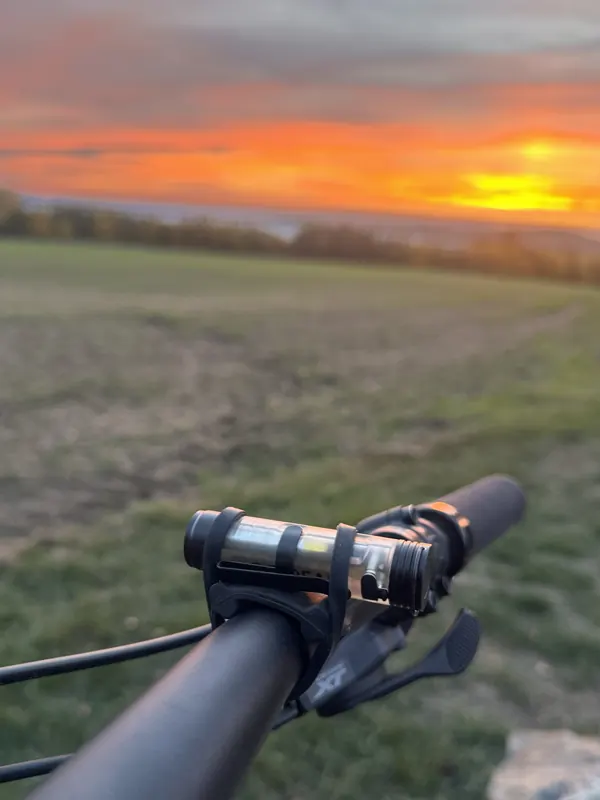
📸 My own experience: I carry the Gopeak Mini as an EDC light in my hip pack, and on the bike whenever there’s a chance I’ll be riding home after dark – it sits on the handlebar in this simple handlebar holder, as in the photo.
The side light is handy in a tent or a hostel dorm, where a full-power beam would wake everyone up.
Lumintop Black Cat

Lumintop Black Cat is a few grams heavier than the Gopeak, but the manufacturer publishes full specs: up to 400 lumens, a 90 m beam and up to 60 h on the lowest setting.
🎯 Best for: When you want a pocket light with more modes and clear manufacturer specs.
- 💡 Up to 400 lumens and a 90 m beam.
- ⏱️ 200 lm for about 2 h, 60 lm 4 h, 16 lm 16 h and 2 lm up to 60 h.
- 🌈 Warm side light, UV and colored RGB modes.
- 🧲 Two-way clip and magnetic tail.
- 400 lumens lasts only 30 s, then drops to 100 lm.
- Reviewers say the magnet is weak and not very useful.
- Only IPX4 (splash resistant).
- No head mounting option listed by the manufacturer.
🚫 Skip it if: You need a proper red light – the manufacturer doesn’t describe the RGB modes as a red night-vision light.
📋 Specs:
- Power: built-in 450 mAh Li-Po, USB‑C
- Output: 400 lm (30 s), 200 lm ~2 h, 2 lm 60 h
- Durability: IPX4, 1 m drop resistant
Alonefire X29

Alonefire X29 is one of the smallest flashlights for a CR123A-size cell. It ships with a disposable lithium CR123A, but according to two independent video reviews it also works with a rechargeable 16340 (RCR123A).
🎯 Best for: A cheap, tough metal light for your car, first-aid kit or emergency kit. A disposable CR123A lasts for years in storage.
- 🔋 Runs on CR123A and rechargeable 16340 (RCR123A) – confirmed by the Everyday Survival Gear review and the Small Model Collector review.
- 💡 Noticeably brighter with a rechargeable cell than with the included CR123A.
- 🔩 Metal body and clip.
- ⏱️ Runtime 10–12 h according to the seller.
- No built-in charging – charge the cell separately or buy a 16340 with USB‑C.
- Reverse polarity protection wasn’t tested by the reviewers.
🚫 Skip it if: You just want to charge your light from a power bank and not think about it. Then the Gopeak Mini or Black Cat is a better fit.
⚠️ Careful: Always insert the cell positive end toward the head and don’t drain it completely. Longer protected 16340 cells may not fit – check the length before buying. Never recharge the included CR123A – it’s disposable.
📋 Specs:
- Power: CR123A (included) or rechargeable 16340 / RCR123A
- Runtime according to the seller: 10–12 h
- Weight: 22 g without battery, 37.4 g (1.3 oz) with battery (measured in a review)
Alonefire X81
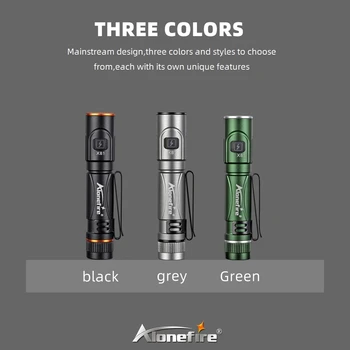
Alonefire X81 is a slim pen-style flashlight for a swappable Li-ion 10440 cell (AAA size). The body weighs 24 g without the cell; add roughly 9–10 g with it.
🎯 Best for: Your pants pocket or the front pocket of a pack, where a wide light gets in the way.
- 🔋 Swappable Li-ion 10440 cell – you can carry a charged spare.
- 🔌 USB charging.
- 🧲 Magnet and clip.
- 💡 Three brightness levels and strobe, according to buyers.
- The seller doesn’t list lumens and states a runtime of only 1–3 h.
- Buyers say it gets noticeably warm on the highest setting.
- Use only a 10440 cell, not a regular AAA battery, unless the seller explicitly allows it.
🚫 Skip it if: You need light for longer – the capacity is too small for a whole evening.
📋 Specs:
- Power: swappable Li-ion 10440, USB charging
- Mounting: magnet, clip
- Runtime according to the seller: 1–3 h
🥾 Lightweight all-round headlamps 51–140 g (1.8–4.9 oz): for hiking, backpacking and emergencies
A balance of weight, runtime and output. Here you’ll find the most versatile headlamp for hiking, the best rechargeable headlamp and a light for your home emergency kit.
Wurkkos HD12

🏆 Best headlamp overall and best value
Wurkkos HD12 is the best headlamp in this guide for around $31. It weighs 106 g (3.7 oz) with the headband, puts out 850 lumens, has a red light, IP68 rating and runs on a rechargeable 14500 cell as well as a regular AA battery.
🎯 Best for: Hiking, backpacking, ski touring and your emergency kit. If you want one headlamp for everything at a reasonable price, start here.
- 🔋 Swappable Li-ion 14500 (900 mAh included) charges via USB‑C right in the headlamp.
- 🆘 In an emergency it runs on a regular AA – alkaline or NiMH, just with lower output.
- 🔴 Red light in three levels: 1, 10 and 30 lumens.
- 💡 Up to 850 lumens and a 105 m beam.
- 💧 IP68 rated.
- 🧲 Magnetic tail cap – pop it out of the holder and use it as a flashlight.
- 850 lumens lasts only about 2 minutes, then drops to 300 lm.
- Users mention a greenish tint and a headband that slips on a helmet.
🚫 Skip it if: You count every gram – the Nitecore NU25 MCT UL weighs less than half as much.
🔄 Higher-quality, pricier alternative: I use the Fenix HM51R myself, but it isn’t sold in the US. Its closest US equivalent is the Fenix HM53R ($69.95 at Fenix Lighting USA): 102 g (3.6 oz) with battery and headband, 1,200 lumens, red light, magnetic tail and IP68. Instead of a AA it uses an 18350 cell, with a 16340 or a disposable CR123A as a backup. For about twice the price you get an established brand sold by a US retailer.
📋 Specs:
- Power: Li-ion 14500 (900 mAh included) or 1× AA, USB‑C
- Output: 850 lm for about 2 min, then 300 lm; red 1–30 lm
- Durability: IP68 (1 m)
Flextail Tiny Helio 600Z
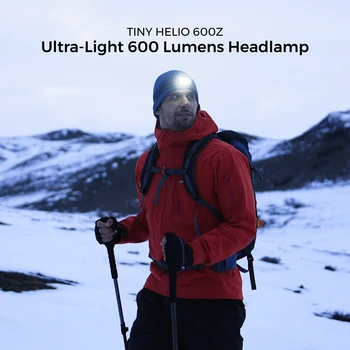
🔋 Lightest rechargeable headlamp with a swappable battery
Flextail Tiny Helio 600Z combines low weight with something small headlamps usually lack: a swappable battery. According to the manufacturer, the 2025 version weighs 62.4 g (2.2 oz) with battery and headband and puts out up to 600 lumens.
🎯 Best for: Backpacking trips and winter. Instead of a power bank, you carry a charged spare battery.
- 🔋 Swappable RCR123A (16340) battery – the manufacturer sells 650 and 900 mAh spares plus a special cold-weather version.
- 🔌 USB‑C charging.
- 💡 Up to 600 lumens; the lowest 1 lm mode lasts up to 100 h.
- 💧 IP67 rated.
- The manufacturer doesn’t list runtimes for individual modes.
- The manufacturer doesn’t list a red light in the specs.
- Operating temperature from −10 °C (14 °F).
🚫 Skip it if: You want a simple headlamp without extra batteries – then the Nitecore NU25 MCT UL is enough.
📋 Specs:
- Power: swappable RCR123A (16340) 700 mAh battery, 650 or 900 mAh spares, USB‑C
- Output: 600 lm, 1 lm up to 100 h
- Durability: IP67, −10 to 45 °C (14 to 113 °F)
Nitecore HA11

🆘 Lightest and cheapest AA headlamp
Nitecore HA11 is a headlamp that runs on a single AA battery. According to the manufacturer, it takes alkaline, NiMH (Eneloop), lithium and Li-ion 14500 cells. It weighs 38 g (1.3 oz) with headband and holder but no battery, and 62 g (2.2 oz) with the included alkaline AA.
🎯 Best for: Home, emergency kits and travel off the beaten path. You can buy AA batteries almost anywhere in the world.
- 🔋 Takes alkaline, NiMH (Eneloop) and lithium AA plus Li-ion 14500.
- 🔴 Red light – steady and flashing.
- 💡 240 lumens and a 90 m beam.
- ⏱️ Lowest mode lasts 75 h on an alkaline AA, 126 h with the NL1411R cell.
- 📎 Headband plus a clip for a cap brim, strap or pocket.
- 💧 IP66 rated.
- No built-in charging – only the optional Nitecore NL1411R cell has USB‑C.
- 240 lumens is enough for walking but too little for a fast descent at night.
🚫 Skip it if: You want maximum output.
📋 Specs:
- Power: 1× AA (alkaline, NiMH, lithium) or Li-ion 14500
- Output: 240 lm, 90 m beam
- Durability: IP66, 1 m drop resistant
Sofirn HS10
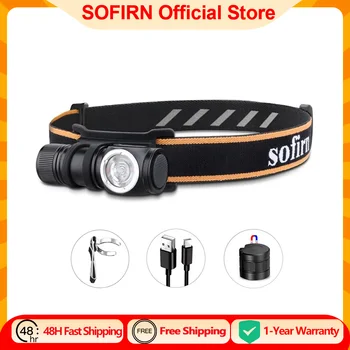
Sofirn HS10 is a small metal headlamp with 1,100 lumens and a swappable 16340 cell – the same format the Fenix HM53R and Flextail Tiny Helio accept. The whole setup with headband weighs 75 g (2.6 oz).
🎯 Best for: Night hikes, camping and chores around the cabin, when you want lots of light in a small body and don’t need red light.
- 💡 Up to 1,100 lumens, a 129 m beam and accurate colors (CRI 90).
- 🔋 Swappable Li-ion 16340 and built-in USB‑C charging.
- 💧 IP68 rated.
- 🧲 Magnetic tail cap and lockout against accidental activation.
- 🌈 Choice of warmer 4000K or neutral 5000K.
- No red light.
- Hard to remove from the headband.
- Small cell – maximum output only lasts briefly.
🚫 Skip it if: You share a tent or read maps at night – without red light you’ll blind others. Get the Wurkkos HD12 instead.
📋 Specs:
- Power: swappable Li-ion 16340, USB‑C
- Output: 1,100 lm, 129 m beam, CRI 90
- Durability: IP68
⛰️ High-output headlamps over 140 g (4.9 oz): for biking, ski touring and the mountains
Heavier, but with the output and runtime for biking, work and long nights. Both Sofirns run on an 18650 cell – the HS42 gives you the most light for the money, the SP40 is the cheaper option without a red light.
Sofirn HS42

💥 Brightest headlamp
I bought the Sofirn HS42 as an all-purpose work and bike headlamp. It’s the most powerful headlamp in this guide: an 18650 battery, both spot and flood beams and a red light.
🎯 Best for: Biking, night descents, work and camping. Thanks to the combination of spot and flood, I also keep it in the car as an emergency light.
- 💡 The most light in this guide – independently measured at ~1,460 lumens (manufacturer claims 2,100 lm).
- 🔦 Long-range spot beam and wide flood.
- 🔴 Red light up to 65 lumens.
- 🔋 Swappable 18650 cell and USB‑C charging.
- 🧲 Magnetic tail cap and lockout.
- 161 g is 55 g more than the Wurkkos HD12.
- The manufacturer doesn’t state a water resistance rating.
🚫 Skip it if: You want it for running – at 161 g (5.7 oz) it’s unnecessarily heavy.
🔄 Alternative: The Sofirn SP40, which I also use, is 20 g lighter (141 g / 5.0 oz), IPX7 rated and comes with a shorter tube for an 18350 cell. But it has no red light and costs only about $2 less, which is why I’d pick the HS42 today.
📋 Specs:
- Power: swappable Li-ion 18650 (3,000 mAh included), USB‑C
- Output: 2,100 lm per manufacturer, ~1,460 lm independently measured
- Red light: 1–65 lm
Sofirn SP40

💸 Budget 18650 headlamp for work and biking
Sofirn SP40 is the headlamp I originally bought for work and biking. It has longer runtime and more output than my Fenix HM51R, which weighs about half as much – and it costs two to three times less than similar headlamps sold in Europe.
🎯 Best for: Work, biking and the car emergency kit – anywhere weight doesn’t matter but runtime does.
- 🔋 Runs on an 18650 for maximum runtime or a shorter 18350 for a more compact setup.
- 🔌 USB‑C charging.
- 🧲 Magnetic tail cap and metal clip – it comes out of the headband and works as a right-angle flashlight.
- 💸 Great value – often a third of the price of similar headlamps in Europe.
- No red light.
- 141 g (5.0 oz) – too heavy for running.
🚫 Skip it if: You want a red light and more output – the Sofirn HS42 is its upgrade.
📋 Specs:
- Power: 18650 or 18350 Li-ion, USB‑C
- Output: up to 1,200 lm (manufacturer)
- Extras: magnetic tail cap, clip, lockout


❓ Headlamp FAQ
What is the best running headlamp?
From this guide, the Nitecore NU25 MCT UL. It weighs 47 g (1.7 oz) with the headband and has 400 lumens, red light and a lockout. Only the pocket lights are lighter, but they lack the output and a comfortable mount for running.
What is the best headlamp for hiking?
For most hikers, the Wurkkos HD12: 850 lumens, red light, IP68 and a battery you can swap for a regular AA. If you count every gram, take the Nitecore NU25 MCT UL; for multi-day backpacking trips with a spare battery, the Flextail Tiny Helio 600Z.
Is a rechargeable headlamp or a battery-powered headlamp better?
For running and day hikes, a USB‑C rechargeable headlamp is the most convenient. For backpacking, winter and travel, a swappable cell or a regular AA is safer – when the light dies, you just swap it. The most versatile models do both, like the Wurkkos HD12 or Fenix HM53R.
What is a headlamp with red light for?
Red light doesn’t blind others in the tent or hut, and your eyes don’t have to readjust to the dark afterwards. It’s handy for reading a map or finding things in your pack. It’s also much less visible from a distance than white light, so it’s useful when you don’t want to be seen. And it disrupts your circadian rhythm less – it won’t throw off your sleep as much in the evening or at night.
How many lumens do I need for hiking and running?
For walking on a trail, 50–200 lumens is enough. For running or descending rough terrain, 200–400 lumens works well. You’ll mostly use over 1,000 lumens on a bike. More important than the maximum is how long the headlamp lasts in the mode you’ll actually use.
How long does a headlamp really last on one charge?
It depends on the mode. “Up to 100 hours” applies to the dimmest setting around 1 lumen. In a medium mode, small headlamps typically last a few hours. That’s why I list runtimes for specific modes wherever the manufacturer publishes them.
Are budget headlamps and flashlights from AliExpress worth it?
Often, yes – the Sofirn HS42 offers output at a fraction of the price of big brands, and I use one myself. The Wurkkos HD12 is another example: 850 lumens, red light, IP68 and both 14500 and AA support for around $31. Many models in this guide, like Nitecore and Flextail, are also popular in the ultralight and outdoor community worldwide, and AliExpress is often the cheapest place to get them. Unbranded lights, though, often lack output and runtime specs, and quality varies from unit to unit. Choose based on reviews with measurements, not the listing title.
🏁 Which headlamp should you get?
- Want one headlamp for everything – hiking, ski touring, biking and the cabin? Get the Wurkkos HD12 – see the deal. A higher-quality but twice-as-expensive alternative from a US retailer is the Fenix HM53R. If you want maximum light and weight isn’t a big concern, get the Sofirn HS42 – see the deal.
- Do you run or do fast hikes and count grams? Get the Nitecore NU25 MCT UL – see the deal, or the Flextail Tiny Helio 600Z – see the deal.
- Heading out on a multi-day trip or in winter and want a spare battery? If weight matters, get the Flextail Tiny Helio 600Z – see the deal. If you want one headlamp that takes both a rechargeable cell and regular AA batteries you can buy anywhere, get the Wurkkos HD12 – see the deal. And if you need maximum light, get the Sofirn HS42 – see the deal.
- Do you travel or want a light for your home emergency kit that runs on batteries you can buy anywhere? Get the Wurkkos HD12 – see the deal, or the lighter and cheaper Nitecore HA11 – see the deal.
- Need maximum light for biking or work, or a powerful headlamp on a budget? Get the Sofirn HS42 – see the deal.
- Looking for a pocket light you’ll always have on you? Get the Gopeak Mini – see the deal.
📖 Related reviews and guides

📌 Budget ultralight gear from AliExpress I actually use
Sleeping bag, stove, titanium cookware, backpacks and both Sofirn headlamps – with weights from my own scale.

🤔 How to think before buying hiking gear
Six approaches to a lighter pack: from minimalism and modifications to DIY and buying second-hand.

🏝️ Hiking across Mallorca on the GR 221
A multi-day trek where a lightweight headlamp with good runtime pays off. Tips on water, camping and gear.
🔬 How I chose: methodology, sources and date checked
I picked the models based on my own priorities: low weight of the whole setup, usable runtime, practical charging and a swappable battery, red light, durability and a reasonable price. I own and use the Sofirn HS42, Fenix HM51R V3.0 and Gopeak Mini, and I weighed them myself (as well as the Sofirn HS10 and the older Sofirn SP40, which I mention as an alternative). I plan to buy the Wurkkos HD12 and will add my experience. The other models, including the Fenix HM53R, are rated based on manufacturer documentation and independent reviews – not my own testing.
I don’t measure lumens in a lab. I list manufacturer data, plus the independent measurement from zeroair.org for the Sofirn HS42. Main sources: manufacturer pages for Nitecore, Flextail, Lumintop, Sofirn and Fenix Lighting USA, plus two video reviews of the Alonefire X29.
Specs checked on October 13, 2026. AliExpress prices change often and differ by country – you’ll see the current price after clicking. I’ll keep this guide updated.




2 Comments